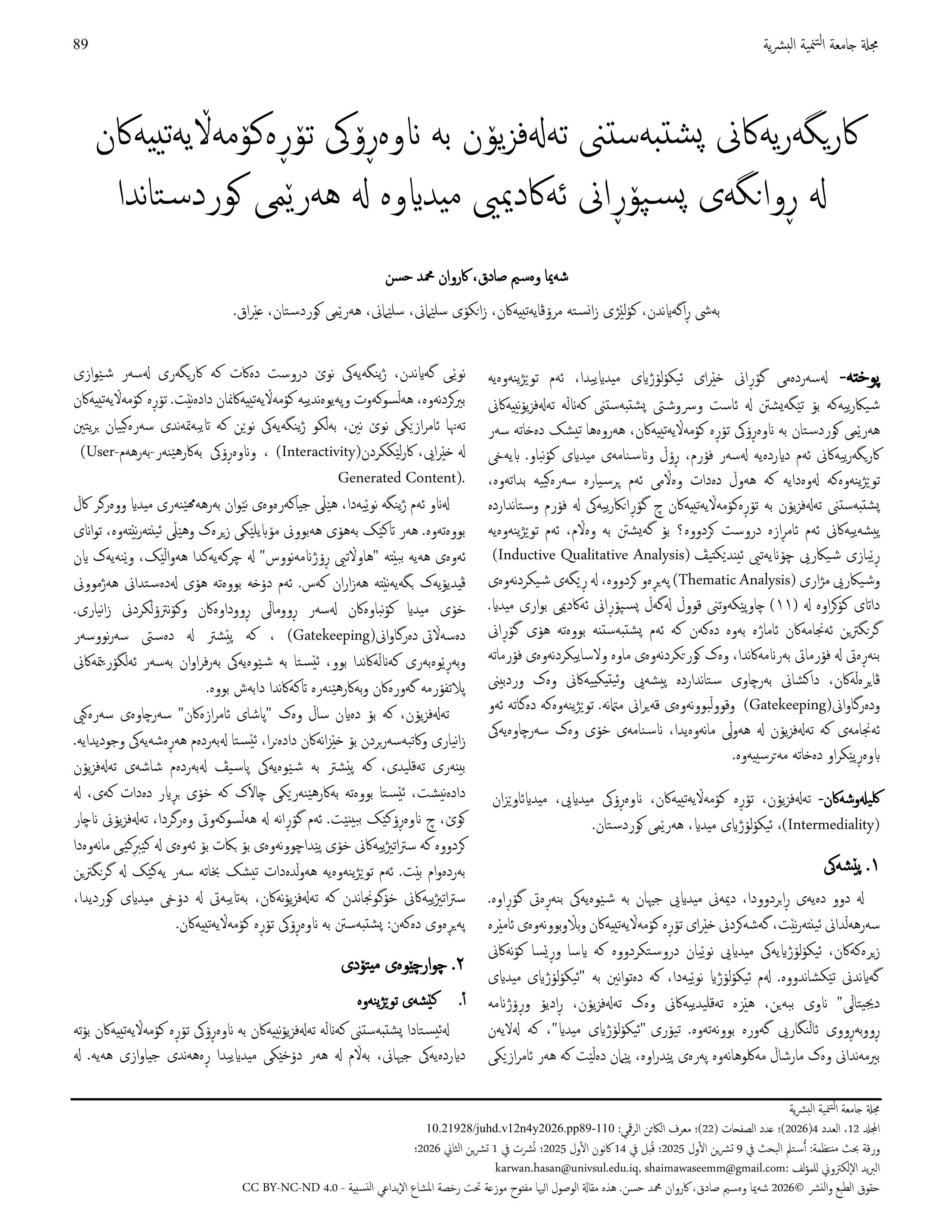
The Effects of Television’s Reliance on Social Media Content from the Perspective of Academic Media Experts in the Kurdistan Region
DOI:
https://doi.org/10.21928/juhd.v12n4y2026.pp89-110Keywords:
Television, Social Media, Media Content, Intermediality, Media Ecology, Kurdistan RegionAbstract
In the era of rapid changes in media ecology, this research analyzes the extent and nature of the reliance of television channels in the Kurdistan Region on social media content. It also highlights the effects of this phenomenon on the form, role, and identity of traditional media. The significance of this research lies in its attempt to answer the following main question: What changes has television's reliance on social media created in the form and professional standards of this medium? To obtain an answer, this study adopted an Inductive Qualitative Analysis approach and Thematic Analysis by analyzing data collected from (11) in-depth interviews with academic media experts. The most significant results indicate that this reliance has led to fundamental changes in program formats, such as shortening duration and imitating viral formats, a significant decline in professional and ethical standards such as verification and Gatekeeping, and a deepening of the trust crisis. The research concludes that television, in its attempt to survive, is compromising its identity as a credible source.
References
Bennett, W. L., & Iyengar, S. (2008). A New Era of Minimal Effects? The Changing Foundations of Political Communication. Journal of Communication, 58(4), 707–731.
Benshoff, H.M. (2016) Film and Television Analysis: An Introduction to Methods, Theories, and Approaches. London: Routledge.
Bizzocchi, J. (2009) The fragmented frame: The poetics of the split-screen. La Web Del Massachusets Intiture of Technology. Available at: http://Web.Mit.Edu/Commforum/Mit6/Papers/Bizzocchi.Pdf (Accessed: 14 September 2025).
Blake, J. (2016) Television and the second screen: Interactive TV in the age of social participation. London: Routledge.
Bolter, J.D. and Grusin, R. (1999) Remediation: Understanding New Media. Cambridge, MA: MIT Press.
Brooke-Rose, C. (1981) A Rhetoric of the Unreal: Studies in narrative and structure, especially of the fantastic. Cambridge: Cambridge University Press.
Brooker, W. (2001) 'Living on Dawson's Creek: Teen viewers, cultural convergence, and television overflow', International Journal of Cultural Studies, 4(4), pp. 456–472.
Caldwell, J.T. (1995) Televisuality: Style, Crisis, and Authority in American Television. New Brunswick, NJ: Rutgers University Press.
Caldwell, J.T. (2003) 'Second-shift media aesthetics: Programming, interactivity, and user flows', in New Media. London: Routledge, pp. 127-144.
Collins, J. (2000) High-Pop: Making Culture into Popular Entertainment. Malden, MA: Blackwell Publishers.
Curtin, M. (2004) 'Media capitals: Cultural geographies of global TV', in Spigel, L. and Olssen, J. (eds.) Television after television: Essays on a medium in transition. Durham and London: Duke University Press.
Evans, E. (2011) Transmedia television: Audiences, new media, and daily life. London: Routledge.
Hallin, D. C., & Mancini, P. (2004). Comparing Media Systems: Three Models of Media and Politics. Cambridge University Press.
Heath, S. (1990) 'Representing Television', in Mellencamp, P. (ed.) Logics of Television: Essays in Cultural Criticism. Bloomington: Indiana University Press, pp. 267-302.
Herkman, J. (2012) Intermediality and Media Change. Tampere: Tampere University Press.
Jenkins, H. (2006) Convergence culture. Where old and new media collide. New York and London: New York University Press.
Jenkins, H. (2008) 'The Moral Economy of Web 2.0 (Part Three)—Pop Junctions', Henry Jenkins Blog, 21 March. Available at: http://henryjenkins.org/blog/2008/03/the_moral_economy_of_web_20_pa_2.html (Accessed: 14 September 2025).
Jenkins, H. (2008) Convergence Culture: Where Old and New Media Collide. New York: NYU Press.
Katz, E. and Scannell, P. (eds.) (2009) 'The end of television? It's impact on the world (so far)', Special edition of The Annals of the American Academy of Political and Social Science, 625. Thousand Oaks: Sage.
Marchiori, D. (2013) Media Aesthetics. Preserving and Exhibiting Media Art. Berlin: ETC Press.
Mellencamp, P. (1990) Logics of Television: Essays in Cultural Criticism. Bloomington: Indiana University Press.
NOORDEGRAAF, J., et al. (2013) Intermediality in Theatre and Performance. Amsterdam: Amsterdam University Press.
Örnebring, H. (2007) 'Alternate reality gaming and convergence culture: The case of Alias', International Journal of Cultural Studies, 10(4), pp. 445-462.
Parry, R. (2011) The Ascent of Media: From Gilgamesh to Google via Gutenburg. London: John Murray Press.
Rajewsky, I.O. (2005) 'Intermediality, intertextuality, and remediation: A literary perspective on intermediality', Intermédialités, (6), pp. 43–64.
Scolari, C.A. (2009) 'The grammar of hypertelevision: An identikit of convergence-age fiction television (or, how television simulates new interactive media)', Journal of Visual Literacy, 28(1), pp. 28–50.
Scolari, C.A. (2013) 'Media evolution: Emergence, dominance, survival and extinction in the media ecology', International Journal of Communication, 7, pp. 1418-1441.
Scolari, C.A. (2023) On the Evolution of Media: Understanding Media Change. Abingdon: Taylor & Francis.
Sinclair, J. and Turner, G. (eds.) (2004) Contemporary World Television. London: BFI Publishing.
Syvertsen, T. (2003) ‘Challenges to public television in the era of convergence and commercialisation’, Television and New Media, 4(2), pp. 155-175.
Thomas, D. R. (2006). A General Inductive Approach for Analyzing Qualitative Evaluation Data. American Journal of Evaluation, 27(2), 237–246.
Turner, G. and Tay, J. (eds.) (2009) Television studies after TV: Under1standing television in the post-broadcast era. London and New York: Routledge.
Uricchio, W. (2004) ‘Television’s next generation: Technology/interface/ flow’, in Spigel, L. and Olssen, J. (eds.) Television after TV: Essays on a medium in transition. Durham and London: Duke University Press.
Waisbord, S. (2004) 'McTV: Understanding the Global Popularity of Television Formats', Television & New Media, 5(4), pp. 359-383.
Williams, R. (1974/1992) Television: Technology and Cultural Form. London: Routledge. (The PDF text cites both original and reprint dates; the bibliography lists the 2003 edition with E. Williams as a co-author).
Williams, R. and Williams, E. (2003) Television: Technology and Cultural Form. London: Routledge.
Downloads
Published
Issue
Section
License
Copyright (c) 2026 Shaima Waseem, Karwan Muhammed Hassan

This work is licensed under a Creative Commons Attribution-NonCommercial-NoDerivatives 4.0 International License.